The Hidden Power of Falling Apart

I don’t know about you, but I have a good bit of cognitive dissonance going on.

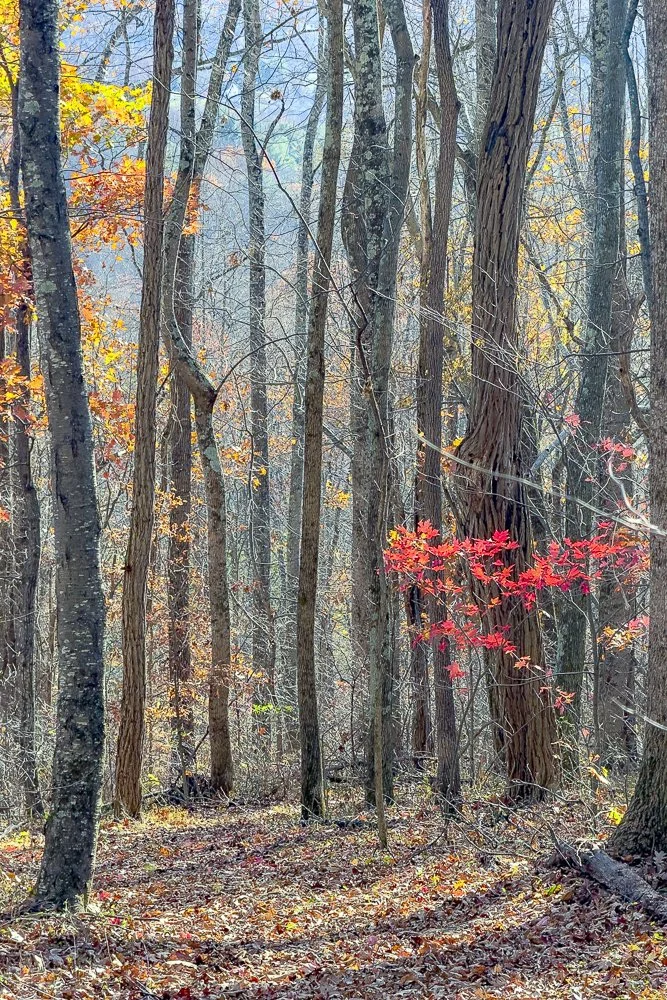
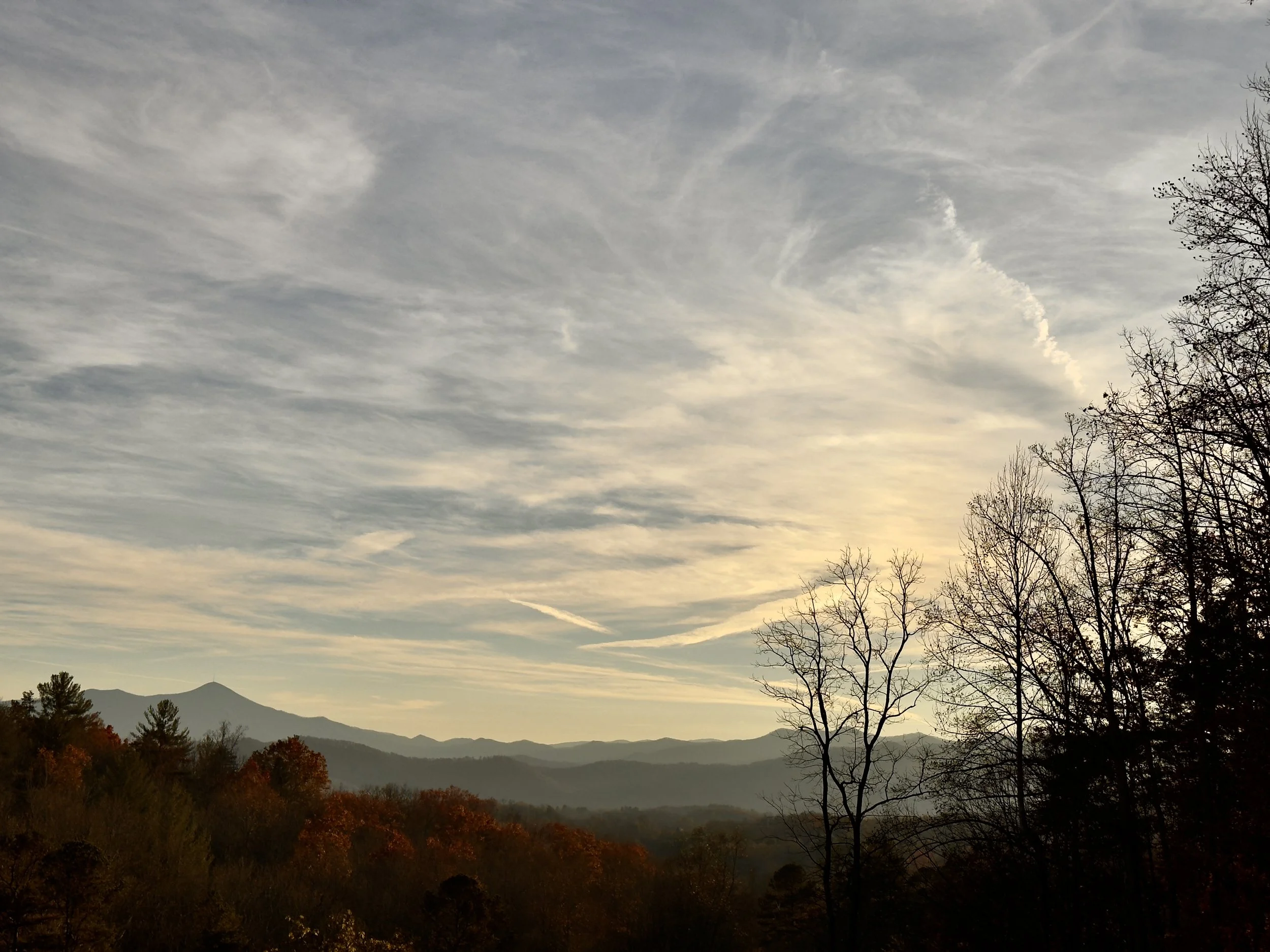
I live in a place of extraordinary beauty—these ancient mountains, this lush forest that holds me in its quiet, steady presence. Every morning, I step outside into air alive with birdsong, feet meeting earth that has been here far longer than I have. I have an adorable puppy who delights me, work that fulfills me, friends who love me, and a strong, healthy body. My life is rich, peaceful, and whole.
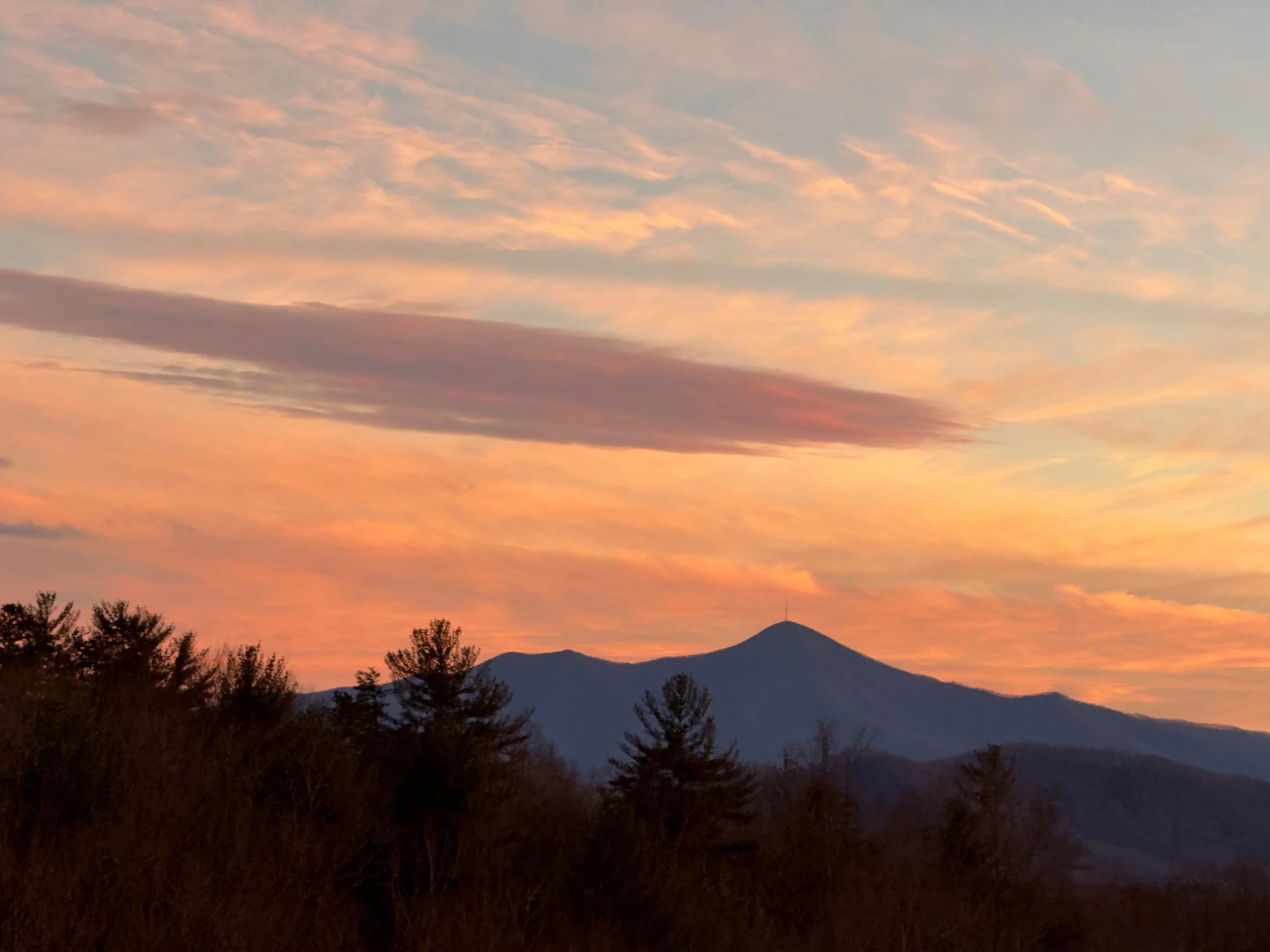
(Evening view from my front porch. ©2025. Carla Royal)

And then—I read the news. All is not well. The world is unraveling.

I scroll, I listen, I watch—and I feel the edges of my reality tear at the seams. I see the fractures widening, the ground shifting beneath us, and I wonder: How do I hold both of these things at once? The beauty and the horror, the peace and the collapse?

A Grief That Splits the World in Two

I remember when my mother died 30 years ago. It wasn’t just her life that ended. It was the end of a world I had known. There was before my mother’s death, and after—and they feel like different lifetimes.

In the months and years that followed, I was swallowed whole by grief and confusion. I remember sitting on my couch, staring out the window, watching people move through their days as if nothing had happened. I wanted to scream: My mother is dead! How can you just go on like nothing has happened?

I meet with clients now, and they ask, How are you? I say, I’m doing well. How are you? And it’s true—I am doing well. But I’m also not doing well. I want to say, I’m doing well, considering the world as we know it is falling apart. How is it for you? But I don’t.

Not everyone sees what I see. Not everyone feels the weight of this unraveling in the same way. Maybe I see more clearly than others. Maybe I don’t. But I know this: I have been here before.

The Descent

When my mother died, I didn’t claw my way out of grief. I didn’t try to rise above it. I didn’t attempt to put myself back together too soon. People wanted to pull me out, to help me move on. But I somehow knew I had to go all the way down. And I did.

There’s a line from an Over the Rhine song I love: "I’m so far down, I’m beginning to breathe."

That’s what it felt like. I thought the depths might destroy me. They didn’t. I thought if I surrendered, I would disappear into the abyss. But what I found, in the deepest dark, was something entirely unexpected: Space. Air. The slow, steady rhythm of breath. Life. The depths were not what I had feared. They did not consume me. They remade me.

And maybe that’s why, years later, I have a client who calls me a hell-walker. I’m not afraid of the depths. I am not afraid of the darkness. My clients know this about me. They know I’ll walk through hell with them. This is my zone of genius. I have been to the bottom and learned to breathe there. And I know that for those willing to stay the course, to surrender to the transformation, something new—something stronger, freer, and truer—emerges on the other side.

What If This is a Necessary Unraveling?

These mountains I live among are hundreds of millions of years old. They have seen forests rise and fall, flooding rivers carve through rock, and fire reshape the land. They have watched entire worlds change, over and over again.

They remind me that everything changes, always. Nothing stays intact forever. Not civilizations. Not systems. Not even us. But something deeper remains.

Joanna Macy calls this time The Great Unraveling. She teaches that we are not simply witnessing destruction—we are living through the breaking apart of an old way, a necessary dissolution.

What if this isn’t just collapse? What if this is compost?

Learning to Breathe in the Freefall

Victor Frankl once wrote, "Everything can be taken from a man but one thing: the last of the human freedoms—to choose one's attitude in any given set of circumstances, to choose one's own way."

We cannot always change our circumstances. But we can choose how we meet them.

Frankl also said, "When we are no longer able to change a situation, we are challenged to change ourselves."

I’m not saying we can’t change this world. I’m saying that if we want to, we must first change ourselves. And if the world refuses to change, we can still change ourselves—or maybe it’s more like returning to our true selves.

The Real Meaning of Preparation

I keep coming back to this idea of preparation. What does it really mean to be prepared? For some, preparation means stockpiling, survivalism, a tight grip on control, or ignoring it completely, hoping for the best. But I don’t think that’s what we need.

I think preparation looks more like building the capacity to stay in the mess without running from it. I didn’t prepare myself to survive my mother’s death. I surrendered to it. And in doing so, I found a resilience I didn’t know I had.

Years later, I discovered Pema Chödrön, and her teachings put words to what I had already experienced: When the ground beneath us falls away, we have two choices: We can panic or learn to breathe in the freefall. Sometimes, we panic first, then surrender and breathe in the freefall.

I won’t lie—I still love my comforts. I don’t want to be uncomfortable. But I also know that comfort is not where transformation happens. And I believe with my whole heart that we are being called into transformation. Only in our transformation will we be able to usher in a new world.

I know what happens when the old world collapses. I know what happens when you let yourself go all the way down. And I know that when you finally stop resisting, you could find your breath and life force again.

Falling apart isn’t the end of the story. It’s how the next one begins.

What about you? Have you ever been undone, only to discover you were becoming something more? I’d love to hear your thoughts. Comment below and share your experience. If this resonated with you, consider subscribing so we can keep walking through the depths together. And if you know someone who might need this today, please pass it on.

The Leap You’ve Been Avoiding—And Why It’s Time to Take It

History moves in leaps—not careful steps. Will you answer the call?

Leap

That’s the word echoing through me right now. A single, insistent whisper. A knowing. Now is the time to leap toward how I am meant to show up in a crumbling world.

Leap, trusting that the wings will appear or the rope will hold.

And even if they don’t, it will have been worth knowing I didn’t stay small inside the illusion of safety, standing still while the ground gave way.

Leap—to manifest my destiny rather than letting the tide of fear and control decide for me.

Just over a decade ago, I bungee jumped for the first time. I thought it would be easy. I spent a few years in college rock climbing and rappelling. I’m not afraid of heights. But standing on that bridge in the mountains of Whistler, BC, I realized something: climbing is about control, but it’s another thing entirely to hurl yourself into the abyss 160 feet above a rocky river that will not cushion the fall.

Humans aren’t meant to hurtle through the ar! My body knew this. I froze.

The young guy coaching me told me something simple but true: It won’t get any easier.

He was right.

No amount of standing on that bridge would dissolve the fear. The only way forward was down. And so, after what felt like an eternity, I dove. I dove!

(That’s me leaping! You can’t see the terror, but it’s there.)

It was terrifying. It was exhilarating. It was worth it.

I won’t do it again—but I will never forget the lesson: Even in the face of paralyzing fear, I can leap. I am capable!

The Cost of Not Leaping

I have also known the opposite of leaping.

I watched my father do everything he could to stay safe and in control. He was meticulous and cautious. Yet, for all his efforts, I never found his life inspiring.

I listened to my mother tell me not to be consumed by what I loved—even as her addictions consumed her. I watched her slowly snuff out her beautiful light.

Might it be better to go out blazing?

Neuroscientist Lisa Feldman Barrett explains that our brains aren’t wired for safety but for survival. The nervous system doesn’t distinguish between the fear of leaping and the quiet cost of holding back; it only tracks the toll. What feels like self-preservation can become self-abandonment—and when we abandon ourselves, we abandon the world.

Adrienne Maree Brown speaks of emergent strategy—the art of adapting and trusting that what we need will come as we move. She says, "How we live and grow and stay purposeful in the face of constant change" is what shapes us. The leap is not just an act of courage—it’s how we participate in our own becoming.

I decided 25 years ago that I would rather die than slowly fade away. Before that, I came close to death, but that decision pulled me forward. And yet, honestly, I haven’t been burning as brightly as I could. But over these past decades, I have built a foundation beneath me, and I have resourced myself well.

Now, it’s time to leap again. Time to blaze.

The World Is Calling Us To Leap

This is not just personal. The world is inviting you to leap, too.

We live in a time when old structures are crumbling economically, politically, socially, and environmentally. The safety nets we once trusted are faltering.

Jean Gebser wrote about mutations in consciousness—how history moves not in straight lines but in great leaps. And in every shift, some try to hold onto what was, and some surrender to what wants to emerge.

The ones who leap can help usher in a new world.

We are being called. Right now.

And yet, we hesitate.

Our nervous systems resist the unknown. We cling to what feels familiar, mistaking it for safety. Deb Dana, an expert in Polyvagal Theory, explains that safety isn’t the absence of risk; it’s the presence of connection. Read that again: Safety isn’t the absence of risk; it’s the presence of connection.

This means we don’t have to leap alone—we aren’t meant to.

We can hold each other through the freefall.

The world is in desperate need of my light. And yours.

So, I’ll ask you what Mary Oliver once asked:

"Tell me, what is it you plan to do with your one wild and precious life?"

I know what my next big leap is, and I’m scared! I’ve decided to take it before I hit publish, even though it frightens me because I’ve learned I can do brave things even when fear is present.

Trembling, I leap. Will you join me?

It will be terrifying. It will be exhilarating. It will be worth it.


Please share your thoughts in the comments. I’d love to hear what this stirs in you. If it resonates, please share it with someone who needs to hear it. If you want more conversations like this, hit the subscribe button. A “like” goes a long way. 🤗

Your Anger Is Not the Problem—Here’s How to Use It as Fuel

The Weight of Anger: Why You Feel It Everywhere

There’s so much anger in the air right now. You can feel it, can’t you? It’s in conversations, in the news, in your body. It’s in the way you clench your jaw when you hear another headline, the way your chest tightens when you see injustice playing out again and again. The world is shifting in ways that feel cruel, like a rising tide meant to drown us. Of course, you’re angry. You should be.

Anger Can Be a Trap—Or a Tool

Anger is what tells us something isn’t right. It’s the fire that keeps us from going numb. But if we’re not careful, that fire can burn us up from the inside. It can turn us reactive, exhausted, and hopeless. And we can’t afford that. Not now. Not when the world needs us awake and steady.

How Anger Affects Your Brain

Anger is powerful. Like any powerful force, it can either sharpen or distort our thinking. The research is clear: unchecked anger can make us reactive, narrowing our focus and making us more prone to snap judgments and more susceptible to misinformation. But appropriately channeled anger can do the opposite—it can cut through the noise, bring clarity, and fuel deep, decisive thinking. When we learn to work with anger rather than be consumed by it, it becomes a force that sharpens our vision instead of clouding it.

A 2005 study by Bodenhausen, Sheppard, & Kramer found that unchecked anger makes us lean on fast, surface-level thinking rather than deep, careful reasoning. But the right kind of anger—the kind that is acknowledged and directed—can do the opposite, sharpening our focus and fueling deeper thought. This is where social media traps us. It doesn’t encourage reflective, purposeful anger. It thrives on raw, unprocessed outrage, keeping us scrolling, engaging, and getting madder and madder. The angrier we are in this reactive state, the less we pause. The less we breathe. The less we think.

This is precisely why I got off most social media sites. I found myself riled up to the point of shaking at times. Between that and the addictive nature of social media, I had to go so I can remain regulated and grounded.

When anger takes over, our amygdala—our brain's fear and aggression center—kicks into high gear, flooding us with fight-or-flight energy. The prefrontal cortex, the part of us that thinks ahead, considers nuance, and makes wise decisions, gets quieter. If we don’t learn to work with this, we end up stuck in cycles of outrage, convinced we’re thinking clearly when, really, we’re being hijacked. We can see the hijack all around us.

History Shows Anger Can Be a Catalyst for Change

That doesn’t mean we need to stuff our anger down. No, no, no. Suppressing anger means it festers. A Harvard study on repressive coping found that people who suppress anger have higher stress, worse health, and a greater risk of depression. If you don’t validate your anger and give it a place to go, it’ll come out sideways through resentment, exhaustion, and explosive outbursts that leave you feeling worse than before or maybe collapsed on your sofa in despair (that one I know well).

Anger has fueled revolutions, toppled corrupt leaders, and propelled people to fight for justice when no one else would. Research by Carver and Harmon-Jones (2009) shows that anger increases persistence—it keeps people in the fight. Lerner and Tiedens (2006) found that anger can make us more optimistic and willing to take the risks needed for change.

But it has to be carefully tended. Not suppressed, not unleashed without thought. Tended. Held. Directed. Used wisely.

(Focused anger. Don’t get too close! Feral Cat in Apalachicola, FL. ©2016 Carla Royal)

How to Transform Anger Into Power

How do we work with anger instead of being consumed by it? How do we let it sharpen us without hardening us?

I’ve spent the last several months studying Polyvagal theory with Deb Dana. This work has been life-changing. It teaches that rather than trying to make anger (or any emotion) disappear, we need to learn to listen to it. What is it telling me? Where is it pointing me? How do I move from reactive to steady?

Terry Real’s work in relational healing echoes this. He says anger isn’t the problem—it’s how we engage with it. When we name our anger and give it space without letting it take over, we reclaim our power.

Understanding this can help us recognize when we’re dysregulated and help us get back to regulation more quickly. This builds resilience in us.

Three Ways to Work With Your Anger

  1. Move it through your body. Exercise, breathwork, shaking, even just standing up and stretching can help. Anger gets stored in the body and stagnates if we don’t move it.

  2. Acknowledge it without letting it run the show. Journaling, naming what’s happening inside you—I’m furious right now because I feel unheard because this isn’t fair—lets you work with the anger instead of just reacting.

  3. Channel it into something tangible. Anger without action is just spinning wheels. Direct it toward something meaningful, whether setting a boundary, creating something, or stepping up in a way that makes an actual impact. But direct it carefully and with intention so you don’t burn the place down.

Holding Complexity: The Key to Thinking Clearly in an Outrage-Driven World

It’s often challenging to hold multiple perspectives at once. Yes, anger can distort thinking, but it can also sharpen it. Yes, anger can be destructive, but it can also be the fuel for justice. Both can be true. We must be able to hold onto that complexity if we want to navigate this world without losing ourselves.

This is hard in a world that thrives on black-and-white thinking and outrage. Social media, the news, and everything around us make it easier to react than to reflect. But we must resist that pull if we want to show up powerfully. We must stay clear-eyed. We must learn to work with our anger so it works for us, not against us.

Your Anger Is Valid

Your anger is not wrong. Your anger makes sense. This world gives you plenty of reasons to be angry. But anger, by itself, isn’t enough. If we don’t learn to work with it, it will burn us down instead of lighting the way forward.

Now more than ever, we need people who can hold their fire without letting it destroy them. We need people who can think deeply, act wisely, and channel their rage into something real. We need people who won’t collapse or explode but will show up—steady, grounded, and ready to do what needs to be done.

That’s you. You are needed. Your anger is needed. Just don’t let it burn you up. Listen to it. Work with it. Use it wisely. The world is waiting.

Stay on Course: Why Focus is the Most Powerful Act of Resistance

In a world built to scatter your attention, reclaiming your focus isn’t just self-care—it’s a revolution. Here’s how to take back your power and do what truly matters.

Everywhere I Turn, Something is Demanding my Attention

The news, the notifications, the endless stream of crises—each one urgent, each one insisting that it matters most. I want to stay informed, bear witness, and do my part. But no matter how much I try to hold, there is always more. The weight is relentless, and if I’m not careful, it leaves me scattered, depleted, and unable to focus on what truly matters.

And that’s exactly the point.

(Douglas Lake, TN. ©2015 Carla Royal)

A System Designed to Keep Us Distracted

I know I’m not alone in this. Many people I speak to feel the same pull, exhaustion, and sense of being stretched too thin. And that’s not an accident. We live in a system designed to keep us distracted. The more fragmented our attention, the harder it is to think critically, reflect deeply, and channel our energy into meaningful action.

That’s why reclaiming our focus is more than a personal choice. It’s an act of resistance. A refusal to be manipulated, depleted, and rendered ineffective. The world needs steady, intentional, intelligent action, not reaction. But that requires discipline—stepping out of the whirlwind and focusing on what’s ours to do.

A Simple Framework for Reclaiming Focus

Recently, I listened to a conversation between Priya Parker and Brené Brown on Unlocking Us. Priya, the author of The Art of Gathering, shared three guiding questions she returns to when the world feels overwhelming:

  • What do I know how to do?

  • Where is the need?

  • How can I do what’s within my reach, with blinders on—trusting that others are doing the same?

These questions offer a way forward—a way to cut through the noise, reclaim our focus, and show up fully—not in every direction at once but in the way that matters most. We cannot do everything, but we can do what is ours to do.

Blinders Aren’t Avoidance—They’re Power

Blinders get a bad rap. People assume they mean avoidance, a refusal to acknowledge what’s happening in the world. But that’s not the kind of blinders I’m talking about. The right blinders don’t make us ignorant; they make us effective. Horses wear them not because they lack vision but because they have too much of it (hello, my highly sensitive friends!). They are easily startled, distracted, and thrown off course without them. The blinders help them stay focused on the path ahead and the work that is theirs.

We need those blinders—not to turn away from reality, but to stay committed to what is ours to carry. To recognize the difference between what calls for our attention and what is merely designed to steal it.

(Serenbe, GA. ©2015 Carla Royal)

Why We Must Protect Our Energy

We need those blinders. Not to turn away from the world, but to stay committed to what is ours to carry—and to release what is not. Neuroscientist Lisa Feldman Barrett explains that our brains have a finite amount of energy each day. We deplete that energy whenever we shift focus, consume more information, or engage in reactive thinking. If we spend it on things we can’t control, we have nothing left for the work within our reach.

Stephen Porges, the creator of polyvagal theory, adds that when we are in a state of constant urgency, our nervous system shifts into survival mode—fight, flight, or freeze. When that happens, we lose access to the very parts of ourselves that allow for deep engagement, creativity, and meaningful change.

And that’s precisely what the world’s noise machine wants—to keep us exhausted, overwhelmed, and disconnected from our power.

Resisting the Pull of Distraction

So, I return to Priya’s questions.

  • What do we know how to do?

  • Where is the need?

  • How can we do what’s within our reach?

The challenge isn’t knowing the answers—many of us already know or have an inkling. The challenge is choosing to focus by putting on our blinders. It’s resisting the temptation to scatter our attention, refusing to let urgency and noise dictate where our energy goes. It’s the discipline of choosing—again and again—to stay steady in what is ours to do.

Your Attention Is Power—How Will You Use It?

That choice belongs to all of us. Each of us has something to contribute, something within reach. Some will build. Some will lead. Some will heal. Some will create. Some will nourish. Some will challenge and disrupt. Some will plant. Some will make phone calls. No one can do it all, but if we each tend to our own piece, the whole is tended. The weight is distributed. Change becomes possible.

(Knoxville, TN. This blind horse knows all about focused attention. ©2006 Carla Royal)

What Is Yours to Do?

I invite you to step back and ask yourself:

What is yours to do?

Not the whole world. Not everything that needs fixing. Just your part. Just the thing that calls to you—the work that’s within your reach. The forces that thrive on our distraction want us exhausted and ineffective. But we don’t have to play by their rules. A scattered mind is easy to control. A focused one is powerful.

Make the Choice to Show Up Fully

Today, I put on my blinders. Not because I don’t care but because I care too much to waste my energy on things I cannot change. Not because I want to turn away but because I want to stay steady in the work that is mine to do. And I invite you to do the same—not in my way, but in yours. If we each focus on what is ours to do, something new becomes possible.

When the World Feels Like It’s Falling Apart: How to Move Through Uncertainty with Strength and Purpose

A World In Upheaval

I read the news this morning and wept.

The struggle is real. I want to stay informed and bear witness—but the relentless firehose of information overwhelms me. I want to hide. I want to check out. But when I take just a peek, I tumble down the rabbit hole. Fear grips me. My breath shortens. It feels like things are unraveling. Power is shifting in ways that make my stomach clench. The air is thick with uncertainty. I can’t tell if we’re on the brink of collapse or transformation—probably both.

Tears come. I feel helpless. My mind catapults into the future, constructing worst-case scenarios.

Then I remember.

At this moment, I am okay.

I remind myself that others before us have lived through times like these—times of upheaval, collapse, and uncertainty—and many have risen, shining like beacons. I remind myself that the old world was never working for all of us. What we’re witnessing may not just be destruction but the painful cracking open that precedes something new. I remind myself that we are resilient, that we were built for this, and that I was born into this moment for a reason.

Still, I grieve. I fear. And I know I’m not alone.

So, what do we do? How do we move through this without collapsing into despair?

(Phinizy Swamp Nature Park, Augusta GA. 2010)

1. Honor Your Fear and Grief: They Hold Wisdom

These emotions are not signs of weakness. They are not distractions. They are intelligent.

Fear heightens our awareness, and grief reminds us of what we love. Research confirms that so-called negative emotions—fear, anger, and grief—are essential to human survival. They help us set boundaries, take action, and adapt. The key is to sit with them long enough to hear what they tell us but not so long that they consume us.

As Rumi wrote:

“Sit with your grief. Pour it tea. Listen to it. Honor it. Let it unravel its pain so you may release yours.”

And when teatime is over, take what you’ve learned and act.

Share

2. Take Action: Transform Fear into Purpose

Despair calls for our attention. If we listen closely, it can reveal what we most long for. But staying in it too long can paralyze us. The way forward is action.

Decide how you want to show up in this moment. There is no one right way. But I don’t mean frenetic action. I mean intentional, meaningful action.

Some are called to protest, write, organize, build, meditate, or create sanctuaries of calm in the storm.

This moment has crystallized my purpose. I’ve spent my life walking into the dark places—my own and others'. My work is about transforming wounds into wisdom, fear into power, and pain into purpose. Now, I’m making it explicit: I want to help those ready to heal themselves and the world. I want to help people who aren’t just seeking success but who also want to make the world more just, whole, and humane.

As Lao Tzu said:

“If you want to awaken all of humanity, then awaken all of yourself. Truly, the greatest gift you have to give is that of your own self-transformation.”

3. Guard Your Energy: Protect Your Mind and Spirit

This is a marathon, not a sprint. If you burn out, you become another casualty of the system you want to change.

Be intentional. Limit your doomscrolling. Step away when needed. Be mindful of what you consume—not just food but media, conversations, and thoughts.

For me, survival means walking in the woods, meditating, writing, listening to music, and staying connected to those who ground me. It’s a balance between knowing and not knowing, between bearing witness and protecting my nervous system.

Get radically honest about what sustains you. And do more of that and less of what doesn’t serve you.

(Bard Owl outside my home in Vermont. 2009)

4. Root Yourself in Community: You Are Not Alone

Even if you tend toward solitude, like me, now is the time to name your people and bring them close.

Decades of research confirm what we already know deep in our bones: Humans are wired for connection. We survive because of each other. Friendship, community, and belonging aren’t luxuries; they’re lifelines.

Who are your people? Who sees you, gets you, and reminds you of what’s real? Reach out. Check in. Gather, even if it’s just over text. Build a web of support that holds you and that you hold in return.

We do not do this alone. We never have.

5. Seek Professional Support: You Don’t Have to Navigate This Alone

It’s okay not to know how to navigate this.

Therapists, coaches, and spiritual guides aren’t just for “fixing problems.” They are essential allies in times of transition. They help us regulate our nervous systems, reframe our fears, and find solid ground in unstable times.

I have my own guides. Without them, I’d be lost.

Who are yours?

6. Hold Space for What Wants to Emerge.

It is easy—natural—to imagine the worst. But fear is only half the story.

The other half is this:

We are standing at the edge of something unknown. And unknown does not automatically mean bad, even if it looks terrible.

History shows us that collapse is often the precursor to rebirth. In the ashes of the old, something new can rise—something more just, whole, and authentic. The systems we relied on were never built for all of us, and maybe they were never meant to last.

“When patterns are broken, new worlds emerge.” — Tuli Kupferberg

“Chaos is the raw material of creation. In times of order, transformation is resisted. But in chaos, it becomes inevitable.” — Unknown

“In the times of greatest chaos, transformation is not only possible—it is unavoidable.” — Unknown

(Dunedin FL, St. Joseph Sound. 2017)

7. Keep Going: Hope Beyond the Unknown

We must not lose hope. Not the flimsy kind of hope that clings to a particular outcome. But the deeper kind—the hope that trusts in something more significant than any single moment in history.

As Václav Havel wrote:

“Hope is not the conviction that something will turn out well, but the certainty that something makes sense, regardless of how it turns out.”

So we keep going.

Not because we know exactly how this will end but because who we become now matters.

Because there is work to do. Because there are fires to tend. Because something new is waiting to be born.

And we are here, now, for precisely this time.

Let’s Keep the Conversation Going

These are heavy times, and no one should navigate them alone. If this resonated with you, I’d love to hear your thoughts—how are you moving through uncertainty? Share in the comments, and pass this along to someone who needs it. If you want more reflections like this, consider subscribing. Let’s keep the conversation going. And a like always brings a little smile to me.

The Fight to Reclaim Our Attention: Why It Matters More Than Ever

I’m still somewhat addicted to my phone. Even though I’ve deleted all social media apps except Substack, I still catch myself reaching for my phone too often. It’s an almost unconscious reflex—my hand moving before realizing what I’m doing.

Other things pull at my attention, too, fragmenting my focus. I often feel a low-level anxiety humming beneath the surface, which isn’t surprising given the state of the world. Scrolling and distraction help me escape it for a moment. But the escape is fleeting.

My attention is no longer my own.

Showy Egret. Fripp Island, SC 2023

The Fight for Focus: Have You Felt It, Too?

The nagging sense that your focus is being pulled in every direction? That your time and energy are no longer entirely yours?

I’ve told myself I want to write, but days slip by without putting words on page. My attention has been bought and sold a thousand times. It’s time for me to reclaim it, gather the scattered pieces, and protect what’s mine.

The ADHD Brain: A Gift and a Challenge

I’m ADHD. I’ve done the testing. I know how my brain works. There are gifts—like my ability to hyperfocus and accomplish in hours what might take others days. And there are challenges, too: unfinished projects and a mind endlessly fascinated by too many things at once.

Social media is hazardous for a brain like mine, though I suspect it’s dangerous for most. It thrives on overstimulation, pulling me into its endless scroll and numbing me. To counteract this, I’ve learned to create moments of quiet and stillness—sitting on my porch, wandering in the woods, and listening to music. These practices help me regulate my nervous system and reconnect with myself.

Forest behind my home in western NC 2024

Learning to Relax: Easier Said Than Done

But it’s not just overstimulation that pulls me away from presence. For years, I’ve noticed how my body tends to stay on high alert, braced for something unexpected, even when there’s no real danger. It’s a pattern I’ve carried with me and one I’ve been slowly unlearning.

Do you know that feeling—when it’s hard to relax, even in the quiet moments?

Here, in the safety of my woods, I’m learning to calm myself. I’m learning to notice when I’m truly safe, to breathe deeply, and to feel at home in my own skin.

Letting Go of Numbing: The Courage to Wake Up

Bit by bit, I’ve been letting go of the distractions and addictions I once relied on to numb or escape. Choosing to live more fully awake hasn’t been easy. Some days, the clarity feels like standing at the center of everything — the beauty, the mess, the ache of the world — and it can be overwhelming. There are moments when I miss the comforting haze of distraction, the way it softened the edges for a fleeting moment.

But the rewards are undeniable. Slowly, I feel my attention coming back to me. I’m beginning to see things as they are, unfiltered and real. Moments feel richer, connections deeper, and my sense of self stronger. I’m learning to hold both the pain and the beauty, and in doing so, I’m discovering what it means to be truly alive.

The Beauty That’s Always Been Here

I’m sitting on my porch after weeks of bitter cold. The sun is warming my skin, the wind brushes gently across my face, and the trees and mountains wrap me in quiet strength. I hear the rustling of leaves, the sharp rhythm of a woodpecker, the chatter of squirrels. My dog, Lucy, crunches an autumn leaf, and the deep gong of my owl windchime—a treasured gift—echoes softly in the breeze.

All this beauty surrounds me. Beauty is always here. But when my attention is elsewhere, I don’t fully experience it.

Do you experience this? Like life is happening all around you, but you’re not fully in it?

Attention Is Power: Here’s Why It Matters

Attention is the most valuable thing we have, yet we give it away easily, which may be why the world feels fractured. What might happen if we reclaimed our attention? Who could we become? How might we show up differently?

Social media connects us and shares information, but it also steals our focus in ways that harm both ourselves and the world. Researchers have found that it’s linked to higher levels of anxiety, depression, and loneliness, driven by comparison, addictive designs, and the constant fear of missing out (FOMO). It fragments our attention, weakens our ability to focus deeply, and disrupts sleep—leaving us depleted and distracted.

It’s not just personal. Social media thrives on sensational content, fueling division and polarization. Consumed by scrolling, we lose sight of the bigger picture and the ways we might help a world that so desperately needs our attention.

The answer isn’t necessarily to give it up entirely but to approach it intentionally. By reclaiming our focus, we not only protect our well-being—we also free ourselves to engage more fully with what truly matters.

Dr. James R. Doty, a neurosurgeon and neuroscientist, puts it perfectly:

“When we lose the power to direct our attention, we can sink into despair and feel we do not have influence over the quality of our lives. If we cannot direct our attention as we choose, it is as if we are giving away the capital we possess to change our circumstances. We are giving away our self-agency.”

Doty doesn’t suggest that we can control everything in life, but he’s right that we can influence it. Attention is agency. And when we reclaim it, we reclaim ourselves.

Reclaiming Attention: A Radical Act of Presence

Reclaiming attention isn’t just about being present. It’s about rediscovering who we are when we’re not pulled in a thousand directions. It’s about creating space for connection, inspiration, and clarity. It’s about living fully in our lives instead of skimming the surface.

The world is heavy right now. The collective stress is palpable, and there is so much we can’t control. But our attention? That’s still ours—if we choose to take it back.

Reclaiming it may feel insignificant at first, but it holds remarkable power. It can change the way we experience life. It can change the way we live. It could change our world.

The sun still warms me, the wind brushes my face, and the mountains stand steadfast around me. I am here. Fully here.

Mountain view from my home in western NC 2024

Where Is Your Attention Right Now?

Where is your attention right now? What might your life look like if you took it back?

If this resonates with you, if you feel the pull to reclaim your scattered attention, I invite you to join me on this journey. Subscribe to Edges of Knowing for weekly reflections, practical tools, and stories to help you reclaim your attention, live fully awake, and transform how you experience the world.

And if this post speaks to you, give it a like or share—it helps others find this space and join the conversation… and it makes my heart smile!